

How Many TEFL Hours Do You Need?
120, 180 or 300 hours?
More hours don’t automatically mean a better TEFL course. The right choice depends on your goals, the depth of training you want, and where you plan to teach.
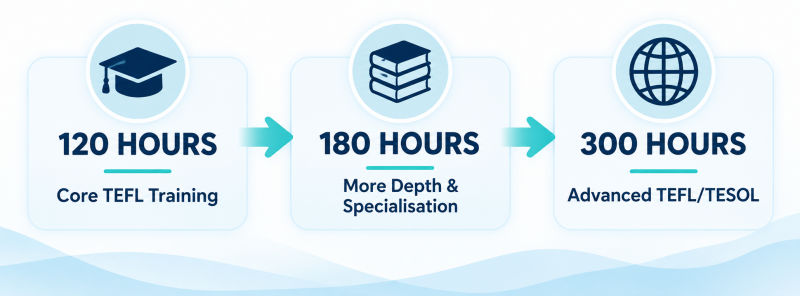

120-Hour TEFL: Core TEFL Training
A 120-hour TEFL course provides the core training needed to build a solid foundation in English language teaching. It is the most common starting point for people preparing to teach English abroad or online.
A good 120-hour course should cover the essential areas of TEFL, including teaching methodology, language awareness, lesson planning, classroom management and the teaching of the four language skills.
A 120-hour course may be the right choice if you:
- Want a solid foundation in TEFL without undertaking an extended programme.
- Are preparing to teach English abroad or online.
- Want to gain the essential knowledge and skills before entering the classroom.
- Prefer a focused course covering the core areas of TEFL.
Remember: course hours are only one part of the picture. When comparing 120-hour courses, look at what is actually included, how thoroughly the material is covered, and whether the training provides meaningful assessment and practical resources.

180-Hour TEFL: More Depth
A 180-hour TEFL course builds on the core knowledge covered in a standard 120-hour programme, providing additional training and greater depth in selected areas of English language teaching.
The additional hours may allow a course to explore specialist teaching areas, classroom techniques and practical applications in greater detail. This can be useful for students who want broader preparation before entering the TEFL profession.
A 180-hour course may be the right choice if you:
- Want more than the core 120-hour TEFL training.
- Would benefit from additional depth and specialist subject areas.
- Want broader preparation for different teaching contexts.
- Prefer a more comprehensive programme without moving to an advanced 300-hour course.
Remember: a higher number of course hours does not automatically mean a better qualification. Look at what the additional hours actually contain, whether the material adds meaningful depth, and how the course prepares you to use what you have learned.

300-Hour TEFL: Advanced TEFL/TESOL
A 300-hour TEFL/TESOL programme provides a more extensive level of training, allowing greater depth across both core and specialist areas of English language teaching.
A longer programme can provide additional opportunities to explore teaching methodology, language systems, classroom practice and specialist teaching contexts in greater detail. It may be particularly suitable for those who want a more advanced level of preparation.
A 300-hour course may be the right choice if you:
- Want a more extensive TEFL/TESOL programme.
- Are looking for greater depth across a broad range of teaching areas.
- Want to explore specialist areas alongside core TEFL training.
- Prefer a comprehensive programme and are prepared to invest more time in your training.
Remember: choosing a 300-hour course does not automatically make someone a better teacher. The value of a longer programme depends on the quality, relevance and depth of the training it provides.
Which TEFL Course Is Right for You?
The right course depends on what you want from your TEFL training.

A focused route covering the essential areas of TEFL. A good choice if you want a solid foundation without undertaking a longer programme.

A broader programme offering additional depth and specialist areas. Suitable if you want more extensive preparation than a standard 120-hour course.

An extensive programme for those looking for greater depth across core and specialist areas and who are prepared to invest more time in their training.
Choose Based On Your Goals
Consider:
- What do you want to teach?
- Where do you plan to teach?
- How much depth do you want from your training?
- How much time are you prepared to invest?
There is no single “best” course length for everyone. The best choice is the programme that provides the level of training and depth that matches your own goals.Take a little time to compare the available courses, then choose the option that best fits your plans.