


Free TEFL Certification
If you are looking for free TEFL certification, a free TEFL certificate, or a free TEFL course with a certificate, there is one important distinction to understand.
Free TEFL training and free TEFL certification are not necessarily the same thing.
Some providers offer their TEFL training completely free but charge separately for certification. Others may include certification at no additional cost.
This page explains what “free TEFL certification” actually means, why certification may involve a fee, how accreditation works, and what you should consider before choosing a TEFL qualification.
What Does “Free TEFL Certification” Actually Mean?
The term “free TEFL certification” can mean different things depending on the provider. Some courses offer completely free training but charge separately for a certificate, while others may include certification at no additional cost.
Before enrolling, check exactly what “free” covers. Is the training free? Is the certificate free? Is certification optional? Understanding this distinction will help you compare courses accurately and avoid unexpected costs.
Free TEFL Training vs Free TEFL Certification
A free TEFL course means that you can access and complete the training without paying a course tuition fee. A TEFL certificate, however, is formal evidence that you have successfully completed the provider's certification requirements. These can therefore be two separate things.

Free TEFL training may include
- Course lessons
- Learning materials
- Activities and exercises
- Quizzes and assessments
- Access to the course for a specified period

Certification may involve
- Completing the required training
- Passing required assessments
- Verification of your results
- Maintaining certification records
- Issuing a digital or physical certificate
- Accreditation or external recognition

Why Can a Free TEFL Course Have a Certification Fee?
If the training is free, you may reasonably wonder why the certificate costs money.
Certification can involve costs that are separate from providing access to the course itself. These may include accreditation, assessment administration, certificate production, record keeping, verification systems and ongoing certification support.
A provider may therefore make its training freely available while recovering some of these costs through optional certification.
The important question isn't simply:
“Does the certificate cost money?”
Instead, ask:
“What am I paying for, and was this clearly explained before I enrolled?”
A transparent provider should make any certification fees and conditions clear before you begin the course.

What Is an Accredited TEFL Certificate?
An accredited TEFL certificate is issued under a certification or quality-assurance system that has been reviewed, approved or recognized by an independent accreditation organization.
Accreditation can provide additional assurance that a qualification has been subject to external standards or oversight rather than relying solely on the course provider's own claims.
However, the word “accredited” should never be taken at face value.
When researching a TEFL qualification, ask:
- Who provides the accreditation?
- What exactly has been accredited?
- Can the accreditation be independently verified?
- What requirements must students meet to receive the certificate?
The answers to these questions are more useful than simply seeing the word “accredited” on a website.

Why Does Accreditation Matter?
The TEFL industry includes courses with very different levels of training, assessment and content.
Accreditation can provide an additional layer of independent oversight and may increase the credibility of a qualification.
However, accreditation is only one part of the picture.
You should also consider:
- The number of training hours
- The quality and breadth of the course content
- The assessment requirements
- Whether teaching practice is included, where relevant
- How the certificate can be verified
- Whether the qualification meets the requirements of the employers you are targeting
A certificate should be judged by what stands behind it, not simply by how impressive it looks.

Digital TEFL Certificates
Many TEFL providers now issue certificates digitally.
For teachers applying for jobs online, a digital certificate can be particularly convenient. It can be stored electronically, sent to employers and uploaded to online platforms when evidence of your qualification is required.
Some digital certificates also include verification information, allowing an employer or other organization to confirm the qualification.
A digital certificate is not automatically less legitimate than a printed certificate.
The format of the certificate does not determine the value of the qualification.
What matters is who issued it, what training it represents, what requirements you had to meet, and whether it can be independently verified.
Some providers also offer physical certificates for students who want a printed copy.

Will Employers Accept a Free TEFL Certificate?
There is no universal rule that every employer will accept every TEFL certificate.
Requirements vary between employers, countries and types of teaching positions.
An employer may consider:
- TEFL training hours
- Course content
- Assessment
- Accreditation or external recognition
- Teaching experience
- Teaching practice
- Academic qualifications
- Visa or nationality requirements
- The specific requirements of the position
Some employers accept a wide range of TEFL qualifications, while others have very specific requirements.
Therefore, “free” does not automatically mean unacceptable, and “accredited” does not guarantee acceptance everywhere.
If you already have a particular country, employer or type of TEFL job in mind, check its requirements before choosing your qualification.
How TEFL Certification Works
Although individual providers have different requirements, the basic process is usually straightforward. A typical certification process involves completing the training, meeting the course requirements, successfully completing the required assessments, and then receiving your certificate.
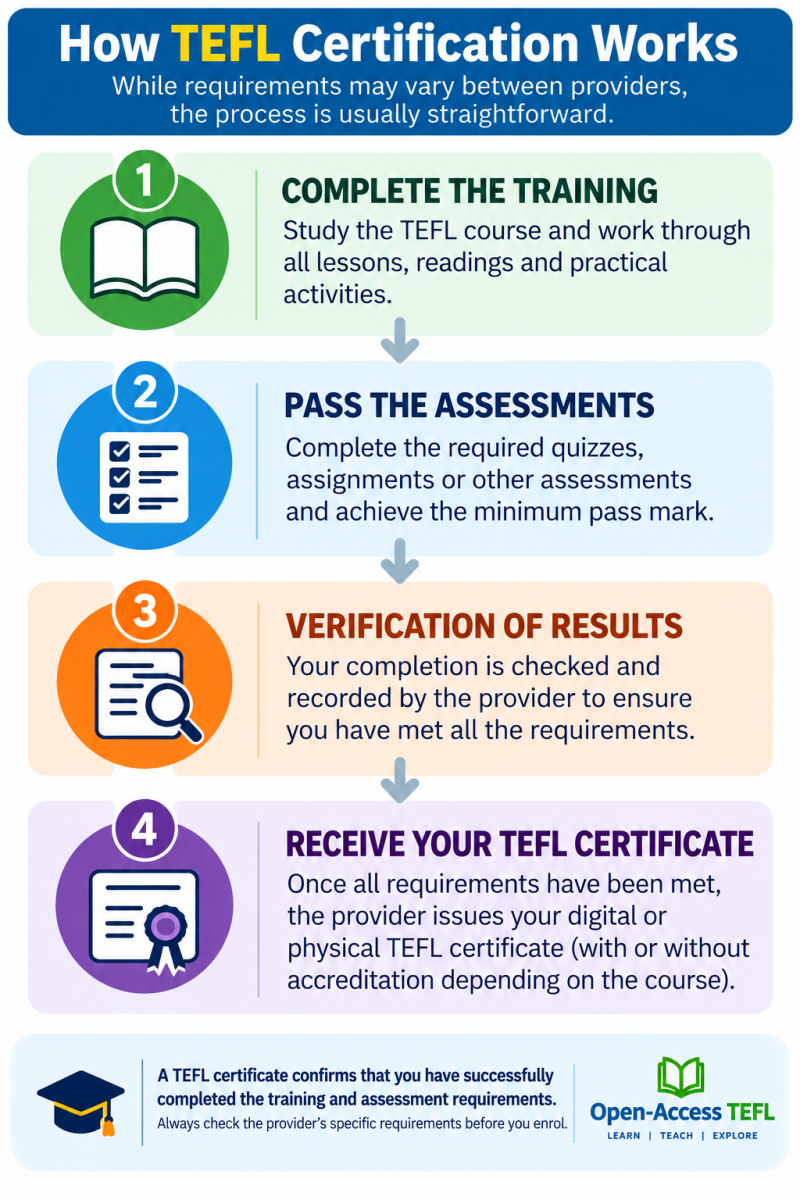
A certificate should represent successful completion of the required training and assessment. Simply registering for a course does not necessarily mean that you have earned a TEFL qualification.
What Should You Look For in a TEFL Certificate?
If you are looking for a free TEFL course with certification options, don't base your decision solely on whether the certificate is free. Consider the complete qualification.
Find a Free TEFL Course With Certification
If you are looking for free TEFL certification, don't limit your search to courses advertising a “free certificate”. Look for a genuine free TEFL course that clearly explains its certification options, requirements and costs. That allows you to complete your training without paying tuition while deciding whether formal certification is something you need.