


Free vs Paid TEFL Courses
Choosing a TEFL course is not simply a question of free or paid.
A paid course is not automatically better, and a free course is not automatically lower quality. What matters is what the course actually provides.
Some free TEFL courses offer only basic or introductory training, while others provide substantial, professionally developed training at no tuition cost.
The key is to compare the course, not just the price.

Free Doesn't Mean Basic
A genuinely free TEFL course can provide substantial training without charging tuition.
Depending on the provider, this may include:
- Comprehensive course content
- Structured lessons
- Teaching methodology
- Specialist teaching modules
- Assessments
- Teaching resources
- Online course access
The fact that students are not paying tuition does not, by itself, tell you anything about the quality of the training.

Paid Doesn't Mean Better
The same principle works in reverse.
Paying for a TEFL course does not automatically mean that you are receiving better training.
Paid courses can vary considerably in:
- Course length
- Content
- Assessment
- Support
- Accreditation
- Teaching practice
- Certification
Price is a cost — not a quality rating.

What Are You Paying For?
One of the most useful questions to ask is what your money actually pays for.
A paid TEFL course may charge for:
- Course development
- Platform access
- Tutor or student support
- Assessment and administration
- Certification
- Accreditation
- Additional resources
Some providers also make their training freely available and separate the cost of optional certification from the cost of studying the course.
This is known as an open-access model.
Free vs Paid
The easiest way to compare the two is to look beyond the price.
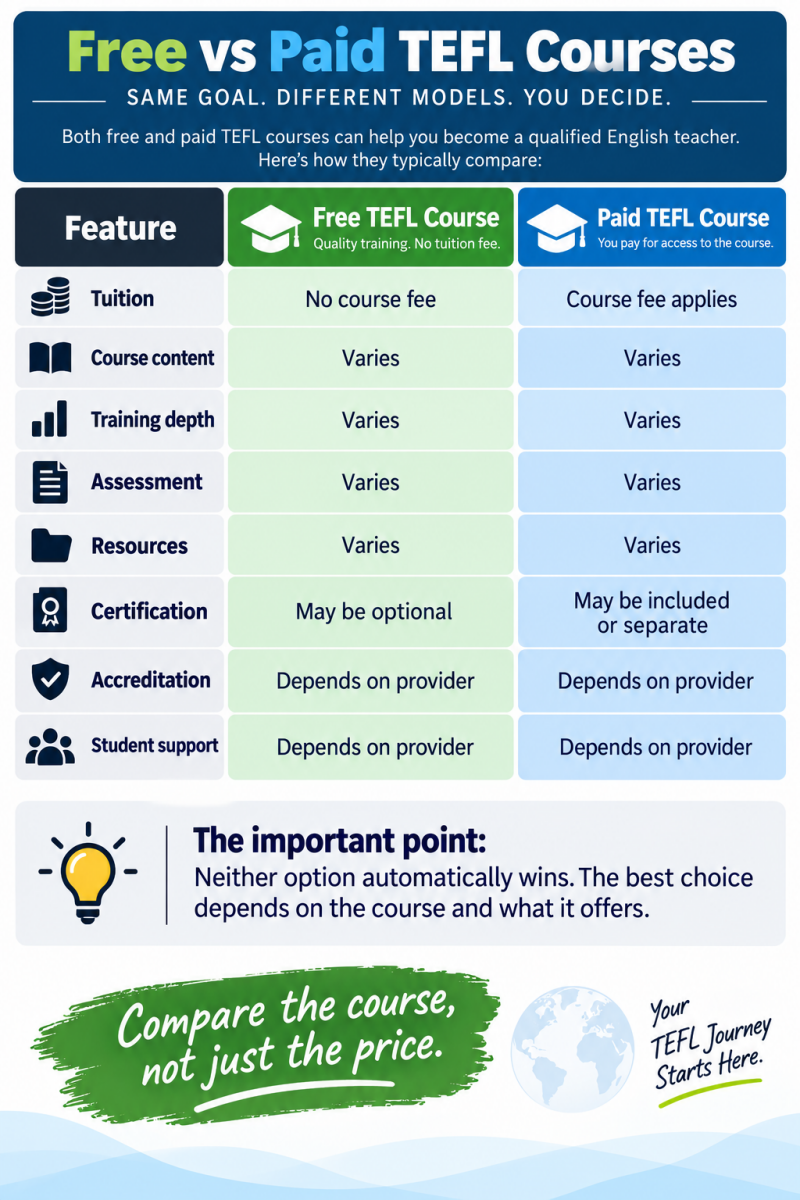
What Should You Compare?
Instead of asking“Is this course free?”, ask:

So, Which Is Better?
There is no universal answer.
A good free TEFL course can be a better choice than a poor paid course.
A good paid TEFL course can offer benefits that a particular free course does not.
Your decision should therefore be based on the quality, depth and suitability of the training, rather than simply whether you have to pay for it.
If you are considering certification, remember that training costs and certification costs are not necessarily the same thing. We explain this in more detail in our Free TEFL Certification page.
Make an Informed Choice
You don't have to pay simply because you assume that paid means better. And you shouldn't choose a course simply because it is free. Compare what you are actually getting - If a free course provides the training, content, assessment and resources you need, it may be an excellent option.